Hotel Oasis del Pacífico is a two floor, 22 room Hotel in Playa Naranjo Costa Rica with 1/2 Kilometer of beach front, 100 meter dock, a field of volleyball, a field of soccer & two swimming pools: one for children and one for adults. Built in 1950, the hotel was totally remodeled three months ago. The hotel is conveniently located 300 meters south of the Playa Naranjo ferry. Contact the hotel for reservations
Showing posts with label Costa Rica. Show all posts
Showing posts with label Costa Rica. Show all posts
Wednesday, February 18, 2009


Monday, January 19, 2009
Buena Vista VII lots now available with owner financing.
We have an exciting new offer on lots in Tierras Morenas of Tilaran. These lots are now offered starting at $2 per meter. Prices have just been reduced and lots are now starting at $29,000. Water and electric is available. 30% down with owner financing. All due and payable in 3 years with no interest and no monthly payments.
Click here for more details on the Buena Vista VII lots for sale
Click here for more details on the Buena Vista VII lots for sale
Friday, November 14, 2008
Playa Naranjo Site Relaunched
JP Wilson Developments is proud to announce the redevelopment of the PlayaNaranjo.net site in order to prepare for a new, fully titled beachfront offering in Playa Naranjo, Costa Rica.
Thursday, November 13, 2008
Take a virtual tour of Buena Vista I at Lake Arenal
Take a look at the new virtual tours showcasing existing luxury homes in JP Wilson Development's exclusive Buena Vista I community.
http://jpwilsondevelopment.com/virtual-tours


Thursday, November 6, 2008
Arenal Volcano National Park
Arenal volcano is the most spectacularly active in Costa Rica. Hotels in the region tout their views of the lava flows and red hot boulders ejected from the volcano glowing in the darkness. Although eruptions are the main attraction, you should be aware that even in the dry season the clouds sometimes obscure the top of the volcano, and your chances of seeing a pyroclastic display are lessened in the rainy season. Volcano watching is better than a fifty-fifty proposition, but you should plan on taking advantage of some of the other attractions in the area, and consider it a bonus if you see Arenal put on a huge display. These tips will also help you maximize your chances of seeing a big pyroclastic show.
 The perfect cone is visible from most anywhere in the area, but if you want a good view of an eruption, your best bet is to stay in one of the "observatory" type lodges, and stay up late or get up with the sun. The clouds tend to move in soon after sunrise. There were hiking tours based out of La Fortuna de Arenal which used to take you up the west ridge to the the crater rim. Because of the number of people killed by ash, falling cinders and toxic fumes, this is no longer allowed. There are still plenty of hiking trails that get you as close as is advisable.
 The perfect cone is visible from most anywhere in the area, but if you want a good view of an eruption, your best bet is to stay in one of the "observatory" type lodges, and stay up late or get up with the sun. The clouds tend to move in soon after sunrise. There were hiking tours based out of La Fortuna de Arenal which used to take you up the west ridge to the the crater rim. Because of the number of people killed by ash, falling cinders and toxic fumes, this is no longer allowed. There are still plenty of hiking trails that get you as close as is advisable.
Chato volcano—this extinct volcano (last erupted a little over 5,000 years ago) has a lopsided crater that cradles a small lake and can be accessed by a hiking trail starting near the Arenal Observatory lodge.
Monday, November 3, 2008
Tax Incentives
This seems to be the one everyone loves! As mentioned earlier the Costa Rican government has created one of the most attractive investment environments in Latin America.
Capital Gains Tax= 0% in Costa Rica. The capital gains taxes are exempt for a business if the money is derived from an activity that is not the normal course of business for the company (This exemption is established through the use of SA, or Sociedad Anonima). Property Taxes in Costa Rica = .25%. This rate is significantly lower than most places in the world. As a result people are buying in Costa Rica which increases demand and ultimately increases value. There are not many places where you can buy a piece of property that has incredible appreciation potential with such low holding costs.
Corporate Tax: The Sociedad Anonima (S.A.)
These forms of corporate structures allow owners of property to keep their names away from the corporations they own (literally translates as “anonymous society”). Ninety percent of all property in Costa Rica is purchased through these S.A.’s. When a property owner purchases property through these S.A.’s they use a shareholder’s loan to fund the purchase. Rental income generated is taken out of the corporation as dividend income and deducted against the initial investment and thus no taxes are paid.
Income Tax: Only income generated in Costa Rica is subject to income tax
Costa Rica offers large amounts of income to be deductible and free from any tax
Proximity to Major U.S. Cities:
When investigating vacation destinations and environments for second homes or investment property, it is important to factor travel times to the destination. Costa Rica’s proximity to major US Cities gives even more reason why investors are buying property in Costa Rica. Great tourist destinations need to be close and easily accessible.
Major US Carriers offer direct flights to and from Costa Rica from the following international airports (3-5 hour flight times)
- Miami
- Houston
- Atlanta
- Dallas
- Chicago
- New York
- Los Angeles
- Toronto
Stable Currency
Investors want to know if their money is safe in Costa Rica.
Stability of the government has helped to maintain a solid and stable currency.
The Costa Rican colon, also denoted as CRC is the official currency of Costa Rica (Currently $1 USD = 557 CRC). Colones come in notes of 1,000 up to 10,000.
US Dollars are also accepted as legal tender in Costa Rica. Both are widely accepted and exchanged throughout the country with approximately 90% of the places of business in the country accepting the US Dollar.


Friday, October 31, 2008
Stable Government
Costa Rica is a democratic republic with three branches of government and has enjoyed one of the most democratic governments in Latin America. As of 1948, Costa Rica abolished it’s army and since 1949 has enjoyed its peaceful democratic existence, often being referred to as the “Switzerland of Central America”.
The government is one of the people and one that very much sees the value of tourism. Over the past few years the government has incentivized foreigners to come and retire in Costa Rica. Stable government ensures that the money you put into your property is safe. Political turmoil will never be a reason for illiquidity in your Costa Rican investment and also provides reason why Costa Rica is a great place to buy. There are many other locations around the world that investors think of to go and buy, but stability is very important and should play a huge factor in anyone’s investment decisions.
The government is one of the people and one that very much sees the value of tourism. Over the past few years the government has incentivized foreigners to come and retire in Costa Rica. Stable government ensures that the money you put into your property is safe. Political turmoil will never be a reason for illiquidity in your Costa Rican investment and also provides reason why Costa Rica is a great place to buy. There are many other locations around the world that investors think of to go and buy, but stability is very important and should play a huge factor in anyone’s investment decisions.
Thursday, October 30, 2008
Excellent Lending market
Prior to 2006, there was no market for lending in Costa Rica and investors bought and sold property on a cash basis. With the recent surge by worldwide and US lenders as well as the strengthening of the Costa Rican market, financing at reasonable rates is now an available option. This addition to the real estate industry has made it possible for many more investors to buy property in Costa Rica and will only increase the demand over time.
As you can see there are many great reasons to invest in Costa Rica. Many people believe that it is too late to make any money. This is not the case! The time is now to invest in this beautiful country and incredible vacation spot.
As you can see there are many great reasons to invest in Costa Rica. Many people believe that it is too late to make any money. This is not the case! The time is now to invest in this beautiful country and incredible vacation spot.
Wednesday, October 29, 2008
How can I finance my property in Costa Rica?
There are two options available for financing home construction.
The first option is for the homebuyer to secure secondary financing (line of credit, second trust note) in their home country. This money, once deposited into escrow, will be held by Title Insurance by LandAmerica Commonwealth Title Of Central America® and will be released in accordance with a pre-defined fund release procedure.
The second option is for the buyer to secure completed home (or take out) financing . This option requires approval in advance by the builder and would require deposits to be made to the escrow account by the buyer during the construction of the home. At the opening of escrow, application is made by the buyer to secure financing against the home once the house is complete. At home completion, the balance owed the developer would be paid and the buyer ends up with a mortgage in Costa Rica for the house.
The second option is for the buyer to secure completed home (or take out) financing . This option requires approval in advance by the builder and would require deposits to be made to the escrow account by the buyer during the construction of the home. At the opening of escrow, application is made by the buyer to secure financing against the home once the house is complete. At home completion, the balance owed the developer would be paid and the buyer ends up with a mortgage in Costa Rica for the house.
Banks & Money
There is an ample selection of state owned and privately held banks in San Jose, and throughout the country. The official currency of Costa Rica is the colon; however US dollars are widely accepted. US dollars and traveler's checks can be changed in banks and hotels. Most major credit cards are widely accepted, and cash advances can be obtained at banks around the country and a variety of places throughout San Jose.

Monday, October 27, 2008
Economy

You don't have to drive very far in Costa Rica -- past the coffee, pastures, bananas, and other crops -- to realize that agriculture is the basis of its economy. Coffee has historically been the country's most important crop, and Costa Rica continues to produce some of the finest coffee in the world. However in recent years less traditional crops have been playing an increasingly important economic role. Bananas are the second most important export crop, with vast plantations covering parts of the Caribbean lowlands. There is also significant land dedicated to the cultivation of pineapples, sugar, oranges, rice, hardwoods, and ornamental plants, as well as raising cattle for beef and dairy products.
Though agriculture remains the basis of the national economy, tourism has earned more than any single export crop during the last few years and the tourism industry continues to grow providing new employment opportunities and stimulating the conservation of our complex biodiversity.
Friday, October 24, 2008
Museums in Costa Rica
Costa Rica museums have inherited a rich and diverse cultural heritage, tangible and intangible, whose purpose is to display and educate present and future generations about our past and present.
The most notable collections include gold, jade, pre-Colombian ceramics and stone pieces, colonial religious art, contemporary art, and natural history.
Costa Rica possesses an important group of museums dedicated to collecting, preserving, and displaying the cultural heritage, and imparting our values. They are located throughout the country and uphold the legacy, which reflects the contributions of the indigenous, Afro-Costa Rican, Asian, European, and Central American populations.
The museums go beyond just collecting, by categorizing and searching for meaning of the past and the present in a didactic way. This allows Costa Ricans to face the future with a sense of identity, community, importance and a complete concept of sustainable human development. In addition, it gives foreign visitors a first-hand look at the towns of yesterday and today that make up our country.
At the end of the last century, a movement arose among some towns to have their own museums. This number of towns has increased.
These are known as community museums and reflect the will of the communities to recover, preserve, share, and communicate the importance of their cultural aspects, whether they be traditions, customs, or local folklore.
These museums have arisen in small towns with a large cultural mix and a rich history and that have shown their commitment to recovery, revitalization and sharing of their traditions, as well as the improvement in the quality of life of its inhabitants.
The most notable community museums are the Abangares Mines museum, the Indigenous Boruca museum, and the Chortega Ceramics museum in San Vicente, Nicoya. These museums are educational, respresentative, and integrating tools within the community, with the goal that the cultural and natural heritage of the local area be respected, valued, and admired as a product of social history to be shared with visitors.
Holidays
| Though government offices and most banks close on national holidays, this causes little inconvenience to travelers, since money and traveler's checks can be changed at most hotels. We recommend that you do not change money on the street. There are days when hardly anything will be open, such as Christmas, New Year, and often a couple of days proceeding, and during Holy Week from Wednesday to Easter Sunday. | ||
Thursday, October 23, 2008
Business Hours
Government offices are generally open from 8:00 am to 4:00 pm, while banks close anytime between 3:00 and 6:00 pm, according to the bank and its branch. Most shops are open from 9:00 am to 6:00 pm, while some open at 8:00 am and others close at 7:00 pm; most grocery stores close at 8:00 pm. Some shops also close for lunch, between noon and 1:00 or 2:00 pm. |
Wednesday, October 22, 2008
Education

Costa Rica is praised because of its efforts for investment in public education that different governments have accomplished throughout the years. There are close to 6,147 elementary, middle, and high schools and more than 50 universities in the country.
The first higher education institution to be established was the University of Costa Rica, which was the only higher educational center up until the year 1971, when the Technological Institute of Costa Rica was founded.
In 1973, the National University of Heredia (UNA) was founded, also the Distance Education University (UNED) was established in 1977, and in the year 1979, the first private institution known as the Autonomous University of Central America (UACA) was created which set the example in 1986 for a large number of other private universities to open their doors in Costa Rica.
Tuesday, October 21, 2008
Medical Services
Despite its size and being an under developed country, Costa Rica has positioned itself among the countries with the highest public healthcare development in Latin America.
The Costa Rican Social Security Service (CCSS) is a public service institution that has accomplished important goals regarding health issues, including pensions and social security. This institution offers coverage and integrated health services through two types of insurance:
General coverage insurance, with a service that covers 100% of the country.
Contribution coverage insurance, with an 86.80% of the population.
Costa Rica is the country in Latin America with the highest life expectancy rate at 77.75 years old; it is also one of the countries with the lowest infant mortality rate: 10.82%. It is also far advanced in issues regarding prenatal prevention and control.

Monday, October 20, 2008
Government
The political system is represented by three powers, which are: The Executive Power, the Legislative Power and the Judicial Power. The Elections Supreme Court is considered the fourth power of the Republic. Every four years national elections are carried out. Among other positions of popular representation, the President of the Republic is elected through direct representation by secret ballot.
CAPITAL CITY: San José
ÁREA: 51,100 km2 (19,730 millas2)

Airports

| The main airport is the Juan Santamaria International Airport, located in Alajuela. This airport is only twenty minutes away from San José. Other important airports are :
There are also landing fields for local flights situated in different parts of the country such as: Limon, Tortuguero, La Fortuna, Tamarindo, Samara, Tambor, Quepos, Palmar North, Golfito, and San Vito. | ||
Friday, October 17, 2008
Transportation
It’s easy to get around Costa Rica, and if you stick with public transportation, traveling within the country can be quite inexpensive. There are bus services to just about every town and city, and high-quality buses serving the main tourist destinations. Taxis are also plentiful and inexpensive, and in San Jose they are required to operate with meters for most trips.
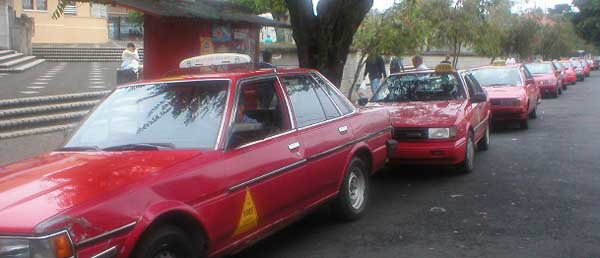
The standard charge for a taxi ride between the international airport and downtown San Jose is $10 US. The quickest way to get around is to fly and several domestic airlines offer daily flights to most of the popular tourist destinations. There are also plenty of car rental agencies, most of which rent four-wheel-drive vehicles.
Subscribe to:
Posts (Atom)


