Monday, July 5, 2010


Country strengthens services to attract foreign retirees


Activity is declared of national interest
Country strengthens services to attract foreign retirees
Goal is that 10,000 renters with high purchasing power live here
Plan aims to stop foreign retirees by $ 340 million annually
Sergio Arce A. | sarce@nacion.com
Published: 2010/02/19


Costa Rica claims that in the years to 10,000 foreign retirees make the country their new home and generate income by $ 340 million annually.

This amount would be received by the country house payments, food, medicine and recreation, but also for the wages of 40,000 new jobs would generate the arrival of this stock, consider the ministries of Foreign Trade and Competitiveness.

The way to crystallize this goal is done by creating communities designed for senior citizens and its importance was reflected yesterday after senior officials from both portfolios signed the document declaring the activity of national interest.

The declaration will allow public institutions such as the Costa Rican Institute of Tourism and the Ministry of Foreign Trade, allocate resources to encourage and promote the creation of these communities.

Now only remains the signing of the decree by the president Óscar Arias and subsequent publication in the Gazette to take effect.

The goal of state and private entrepreneurs from the real estate and health is that communities for retirees have specialized services for medical care and recreation.

In addition, efforts are made that are relatively close to hospitals, shops, beaches and mountains.

The idea is attractive to the country, which now heads for the formation of a cluster or cluster of related companies and attracting attention of foreign retirees, said Jorge Woodbridge, Minister of Competitiveness.

Among the companies that have shown interest include hospitals and private clinics, especially those with international certification, as awarded by the Joint Commission International (JCI).

First steps. According to the strategy, Costa Rica and attract U.S. and Canadian retirees, primarily Florida, Arizona and Texas.

The focus will be on those over 65, better known as baby boomers, those born shortly after World War II and the early 60s.

With the plan, Costa Rica offers foreign rentiers maximum tax exemptions.

The amounts range from $ 5,000 to import the new resident vehicle and $ 10,000 when it comes to utensils brought from home.

Also valued the option to give some kind of exemption on income tax, but is still under study.

Another benefit that is offered to this population is that their residence formalities will be conducted in a single window in the General Directorate of Migration.

This plan also identifies potential areas where they are located or operate from now these special communities.

These include the area around Lake Arenal in Tilarán, Guanacaste, Orosi, Cartago, Miramar, Puntarenas, and Poas volcano.

One of the projects aimed at retirees and foreign works in San Pedro de Poas, Alajuela province.

This is the Mountain Refuge, which since July 2009 serving older adults who chose Costa Rica as their new home.


Ronald Garcia, the owner, explained that the property has a center with 10 rooms and a villa, and invested $ 400,000 in this project.

High Points

Certificacionese investments

Underpins the Government hospitals and private clinics that have international certification, which he says generates "greater peace of mind" to foreigners. For example, hospitals Bible, the Catholic and Cima are certified by JCI. Besides, here there are many transnational companies of U.S. origin. 60% of FDI comes from that country.

Around Lake Arenal in Tilarán, Guanacaste, and are the target of government and private sector to foreign retirees living there with high purchasing power. In the background the volcano Arenal.


http://www.nacion.com/ln_ee/2010/febrero/19/economia2273664.html

Wednesday, January 13, 2010

The Happiest People


Published: January 6, 2010

SAN JOSÉ, Costa Rica

Fred R. Conrad/The New York Times

Nicholas D. Kristof

Hmmm. You think it’s a coincidence? Costa Rica is one of the very few countries to have abolished its army, and it’s also arguably the happiest nation on earth.

There are several ways of measuring happiness in countries, all inexact, but this pearl of Central America does stunningly well by whatever system is used. For example, the World Database of Happiness, compiled by a Dutch sociologist on the basis of answers to surveys by Gallup and others, lists Costa Rica in the top spot out of 148 nations.

That’s because Costa Ricans, asked to rate their own happiness on a 10-point scale, average 8.5. Denmark is next at 8.3, the United States ranks 20th at 7.4 and Togo and Tanzania bring up the caboose at 2.6.

Scholars also calculate happiness by determining “happy life years.” This figure results from merging average self-reported happiness, as above, with life expectancy. Using this system, Costa Rica again easily tops the list. The United States is 19th, and Zimbabwe comes in last.

A third approach is the “happy planet index,” devised by the New Economics Foundation, a liberal think tank. This combines happiness and longevity but adjusts for environmental impact — such as the carbon that countries spew.

Here again, Costa Rica wins the day, for achieving contentment and longevity in an environmentally sustainable way. The Dominican Republic ranks second, the United States 114th (because of its huge ecological footprint) and Zimbabwe is last.

Maybe Costa Rican contentment has something to do with the chance to explore dazzling beaches on both sides of the country, when one isn’t admiring the sloths in the jungle (sloths truly are slothful, I discovered; they are the tortoises of the trees). Costa Rica has done an unusually good job preserving nature, and it’s surely easier to be happy while basking in sunshine and greenery than while shivering up north and suffering “nature deficit disorder.”

After dragging my 12-year-old daughter through Honduran slums and Nicaraguan villages on this trip, she was delighted to see a Costa Rican beach and stroll through a national park. Among her favorite animals now: iguanas and sloths.

(Note to boss: Maybe we should have a columnist based in Costa Rica?)

What sets Costa Rica apart is its remarkable decision in 1949 to dissolve its armed forces and invest instead in education. Increased schooling created a more stable society, less prone to the conflicts that have raged elsewhere in Central America. Education also boosted the economy, enabling the country to become a major exporter of computer chips and improving English-language skills so as to attract American eco-tourists.

I’m not antimilitary. But the evidence is strong that education is often a far better investment than artillery.

In Costa Rica, rising education levels also fostered impressive gender equality so that it ranks higher than the United States in the World Economic Forum gender gap index. This allows Costa Rica to use its female population more productively than is true in most of the region. Likewise, education nurtured improvements in health care, with life expectancy now about the same as in the United States — a bit longer in some data sets, a bit shorter in others.

Rising education levels also led the country to preserve its lush environment as an economic asset. Costa Rica is an ecological pioneer, introducing a carbon tax in 1997. The Environmental Performance Index, a collaboration of Yale and Columbia Universities, ranks Costa Rica at No. 5 in the world, the best outside Europe.

This emphasis on the environment hasn’t sabotaged Costa Rica’s economy but has bolstered it. Indeed, Costa Rica is one of the few countries that is seeing migration from the United States: Yankees are moving here to enjoy a low-cost retirement. My hunch is that in 25 years, we’ll see large numbers of English-speaking retirement communities along the Costa Rican coast.

Latin countries generally do well in happiness surveys. Mexico and Colombia rank higher than the United States in self-reported contentment. Perhaps one reason is a cultural emphasis on family and friends, on social capital over financial capital — but then again, Mexicans sometimes slip into the United States, presumably in pursuit of both happiness and assets.

Cross-country comparisons of happiness are controversial and uncertain. But what does seem quite clear is that Costa Rica’s national decision to invest in education rather than arms has paid rich dividends. Maybe the lesson for the United States is that we should devote fewer resources to shoring up foreign armies and more to bolstering schools both at home and abroad.

In the meantime, I encourage you to conduct your own research in Costa Rica, exploring those magnificent beaches or admiring those slothful sloths. It’ll surely make you happy.

Costa Rica Any Way You Want It

Michael Nagle for The New York Times

White-water rafting on the Pacuare River.

Published: March 22, 2009

THINK of Costa Rica as a Rorschach test for travelers. Outlined on a map, it has no recognizable shape. But enclosed in tropical lines of latitude, with appropriate squiggles for mountains, coasts and interior borders, it's an inkblot for projecting travel fantasies. Beach lovers trace the craggy coasts and see hammocks swinging in the sunset breeze. The eyes of the nature-minded glaze when they note all the national parks. And adrenaline fanatics fixate on the mountains and rivers.

Costa Rica is tiny, smaller than West Virginia, but huge in versatility, with coasts on two oceans, coral-lined beaches and active volcanoes, luxury resorts and surf camps, roaring streams and rich biodiversity. Planning a trip for myself and my father last November, I set myself a challenge. How many Costa Ricas could we sample in just eight days? I settled on three: the rich primordial forest, the adventurer's playground and the beachfront paradise. After subtracting travel time within the country, we would have a day and a half to two and a half days at our chosen location for each one, time enough for a taste, at least, of the country's riches.

Eco-Tourism:
Monteverde

I stared into the dark jungle, hoping to see something staring back. The blackness was not complete; overhead the outlines of banana trees let in a little starlight, and, of course, for walking through the forest at night we all carried flashlights. Like most tourists, I had come to the Monteverde Cloud Forest Reserve in hopes of seeing big mammals like jaguars, ocelots or tapirs. I didn't. Almost no one does. But 10 minutes with a guide on a three-hour walk our first night in the reserve proved that the plants and insects can be just as captivating — and as deadly.

The guide, who introduced himself only as Christian, combined the laid-back attitude of a surfer with the taxonomic command of an evolutionary biologist. He showed us an alligator tree, whose broad, conical spikes were developed to repel the elephant-size sloths that roamed the Americas as recently as 10,000 years ago. He grew animated as he called us over to look at a strangler fig, which begins life as an innocent epiphyte delivered into an unsuspecting tree's branches by a bird, then grows vines up to the sunlight and down to the ground, eventually enveloping the host tree and strangling it.

In a hole in the dead tree, behind the sinewy crawl of fig roots, Christian shined his light on an orange-kneed tarantula perched at the entrance, waiting for its prey. Why didn't it hunt out in the open, someone asked? Christian explained that tarantula wasps live in the area, waiting to paralyze a tarantula with their sting, lay eggs inside it and wait as the wasp larvae slowly consume the still-living spider from within. Let's see an ocelot try that.

Situated in the Tilarán Mountains northwest of San José, Costa Rica's capital, Monteverde is a Disneyland for eco-tourists. With its verdant cloud forest and 1,000 endemic plant species, Monteverde offers the pilgrimage to nature that many seek from the tropics. Since tourists are unlikely to spot all the wildlife they might wish to, private guides have always operated in the reserve, and in recent years, privately run zoo-like exhibitions have popped up: a bat jungle, a frog pond, a butterfly garden, a serpentarium. Add an organic cheese factory, a fair-trade coffee plantation and a half-dozen high-end hotels that vie to outdo one another with their recycling programs and renewable energy projects, and Monteverde has all senses of the word “green” covered.

Twenty-seven percent of Costa Rica's land area is devoted to national parks and reserves, one of the highest percentages for any country. Monteverde, which is the primary place marketed to eco-tourists, is between two reserves — Monteverde and Santa Elena — deep in the Costa Rican highlands. It is well developed, with hotels, several restaurants, shops and art galleries. It even has an asphalt road connecting the two reserves and villages between, which is curious since the four-hour drive through farms and orchards to get to the area from San José is rocky and rutted — a result, locals say, of an earlier desire to keep down the number of visitors (now, most would prefer that the government pave the road). It is an oasis of infrastructure amid the rural and the wild.

We stayed at the Hotel Belmar, off the main drag between the town and the Monteverde reserve. Most people make reservations for the various activities through the hotels because guides are recommended. For those with keen wilderness eyes or their own binoculars or both, it is possible to walk through the reserves unguided.

The next day, our only full day in the area, brought sunlight and a decidedly more benign face from nature. Inside the Monteverde reserve, weaving among clusters of people with their own guides and tripod-attached spotting scopes, our tour group passed huge, leafy elephant ear plants and miniature orchids no more than a millimeter or two across. Monkeys howled and birds twittered overhead, and we spotted a sloth sleeping out the day, matted gray fur tucked into a cradle of branches 20 feet up.

The real joy-bringers were the hummingbirds, sporadic companions within the reserve but constant ones just outside it, where sugar-water feeders were set up. The names by themselves were enough to force smiles: green-crowned brilliants, purple-throated mountain-gems, coppery-headed emeralds! The most dramatic were the violet sabrewings with their white tail feathers and iridescent bodies, purple like a royal robe. Around the feeders, the hummingbirds buzzed by our ears like a squadron of propeller planes. No wonder: with only nectar for food and heart rates of as high as around 1,200 beats a minute, these birds live in a nonstop sugar rush.

Looking for animals in a nature preserve is a bit like playing blackjack in a casino: you know the odds are against you, but at least it feels like skill when you win. Not quite sated with birds and bugs and plants, I decided to stack the deck and take a taxi to El Ranario, a private frog pond. But the frogs still required some effort to spot, blending in against the leaves and soil of their somewhat dilapidated cages. The blue jeans frog (red with blue legs) was no larger than a thumbnail, while the bodies of the glass frogs were completely translucent. But by far the best frog to find behind glass was the “chicken-eating frog” — a bull frog the size of a small cat that is said to eat chicks when given the opportunity. Confronted with that monster frog in the jungle at night, armed with only a flashlight, I may well have turned and run.

Adventure Tourism:
Turrialba

“Will there be cliffs we can jump off of?” Jana Hoffman asked our guide, her native Minnesota accent creeping in. We were in a lull on an 18-mile white-water run down the Pacuare River near the town of Turrialba. Ms. Hoffman and her husband, Dan, on their honeymoon, were on the starboard side of the raft. My father and I held the port, paddles at the ready. Rudolfo Camacho (called Chalo), the guide, a burly, mustached man in his 40s, grinned and nodded to Ms. Hoffman.

But we had rapids to navigate first. The one coming up was Class IV: major obstructions, big, unavoidable waves, distinct risk of flipping — in short, fun.

Monday, November 23, 2009

Real estate of Costa Rica attracts foreign investors Costa Rica


| 05/10/2009 | CA, Panama and the Caribbean In Geneva and Dubai they would be interested in acquiring properties ticas. Carlos Vílchez Navamuel, Consultant of Real estate, expressed in the Republic: " The European begin to see Latin America like a good place for the investment, the Arabs as soon as they know us, but could invest. The North Americans or have made great investments, in technology, services and real estate, we can be asked then why it they could not do the European or the Arabs of countries moderados". In addition, Vílchez Navamuel emphasized the initiative of the Costa Rican government to establish diplomatic relations with moderate Arab countries, " what allows to think about the commercial possibilities and of investment that abren from those latitudes" , and the Free Trade Agreement that is negotiating with the European Community.


Wednesday, July 8, 2009

Costa Rica tops list of 'happiest' nations


CNN) -- Forget Disneyland! Costa Rica is the happiest place in the world, according to an independent research group in Britain with the goal of building a new economy, "centered on people and the environment."

Costa Rica is known for its lush rain forests and pristine beaches.

In a report released Saturday, the group ranks nations using the "Happy Planet Index," which seeks countries with the most content people.

In addition to happiness, the index by the New Economics Foundation considers the ecological footprint and life expectancy of countries.

"Costa Ricans report the highest life satisfaction in the world and have the second-highest average life expectancy of the new world (second to Canada)," the organization said in a statement.

They "also have an ecological footprint that means that the country only narrowly fails to achieve the goal of ... consuming its fair share of the Earth's natural resources."

The Central American country, tucked between Nicaragua and Panama, touts its lush rain forests and pristine beaches. Its president, Oscar Arias Sanchez, won the Nobel Peace Prize in 1987 for trying to help end civil wars in several Central American countries.

This year's survey, which looked at 143 countries, featured Latin American nations in nine of the Top 10 spots.

Don't Miss

The runner-up was the Dominican Republic, followed by Jamaica, Guatemala and Vietnam.

Most developed nations lagged in the study.

While Britain ranked 74th, the United States snagged the 114th spot, because of its hefty consumption and massive ecological footprint.

The United States was greener and happier 20 years ago than it is today, the report said.

Other populous nations, such as China and India, had a lower index brought on by their vigorous pursuit of growth-based models, the survey suggested.

"As the world faces the triple crunch of deep financial crisis, accelerating climate change and the looming peak in oil production, we desperately need a new compass to guide us," said Nic Marks, founder of the foundation's center for well-being.

Marks urged nations to make a collective global change before "our high-consuming lifestyles plunge us into the chaos of irreversible climate change."

The report, which was first conducted in 2006, covers 99 percent of the world population, the statement said.

Tuesday, April 28, 2009

Tycoon of Wall Street trusts Costa Rica

Pensioners of the United States will continue investing in local real estate, although their savings have been affected.

Tycoon of Wall Street trusts Costa Rica

The world-wide economy will not recover soon, assures Henry Kaufman

President of the company that takes its own name, Henry Kaufman, was Managing Director of Salomon Brothers, as well as member of the meeting of Lehman Brothers, in addition he acted as economist of the Federal Bank of Reserve of New York at the moment is making businesses in Costa Rica through Avalon Condominiums

What advantages see in Costa Rica with respect to other countries of the region?
One of the aspects that please to me more is the climate.

In what segment it finds opportunities?
Mainly in real estate. I have been seeing a great number of condominiums. I see an opportunity of strong migration of retired people to maintain its quality of life that strongly has been struck and Costa Rica is the option to a smaller cost.

How they have been seen affected the bottoms of retirement in the United States?

The bottoms of savings have been seen very affected in until a 40%.

With whom it has been talking in Costa Rica on investments?

I have been in negotiations with several developers, would want to invest here in projects directed for distant people who are lost part of their resources.

Companies like Bear Stearns, Goldman Sachs, Morgan Stanley, Merrill Lynch, Lehman Brothers were advised some years ago by you, which is its opinion on the happened thing in Wall Street?

It is a terrible situation that never had to happen. These corporations grew in an unmanageable size and were handled by shareholders and not by partners. The partners handled the companies with responsibility whereas the shareholders had the bottoms they threw and them to the personal accounts and they handled everything with greed.

At the most will extend the crisis?
For a long time, for years.

Which is its opinion on the policies that president Obama has implemented to palliate the crisis?

It has been a slow erosion of Capitalism and are entering a phase of socialism very similar to the Swedish model. What it worries to me is that the people in charge to cause the crisis like Goldman Sachs and Bank of America, among others, did not know to anticipate what came and now are in charge of looking for the solution with the government of Obama.

Which are the main changes that the crisis to the investors will bring?

The credibility was destroyed and after that no financial system it is going to walk well.

Which is its advice for the new runners who do not have the experience?

To look for a mentor and to become of an inexperienced student in one wise person. To learn of the best ones and to have the opening to instruct itself.

How it obtained yield in 2008?

While some invested and invested in bonds of Wall Street I bet by real estate. This against which all thought that it was good business, but in 2008 people lost money and my investments bloomed.

Why it chose other zones to invest outside the United States?

The United States becomes with a difficult future. The budgets of that country have been restricted and they do not have the money to operate. In its place the capital has been destined to save corporations that have recommended the experts to let them quiet to purify the system.

He is recommendable to continue financing these companies?

The United States does not have capacity to continue for a long time maintaining to inject resources to the companies. It must borrow to China, Saudi Arabia and South Korea that buy bonds of the United States, but what happens they stop when them buying for being little attractive?

Personal data Name: Henry Kaufman Occupation:
Investor Birth: Germany, 1927
Professional profit: To have been a running greater intern of Wall Street where he was expeditious to transactions between great companies by sum of million dollars
Pastimes: the numbers

http://www.larepublica.net/app/cms/www/index.php?pk_articulo=24121
Source: Newspaper La Republica

Friday, April 24, 2009

Buying land in Costa Rica


You may not be aware of this, but in order to purchase land in Costa Rica, you do not have to be a legal resident or citizen.
Costa Rica is a very foreigner friendly country and the government is stable.
Costa Rica has no army, but there is a treaty between the U.S. and Costa Rica from 1948 which declares that should Costa Rica ever be threatened, the U.S. army will step in to ensure peace.
Costa Rica is in every way the kind of place that anybody with money for an additional house or piece of property should consider buying in.
Costa Rica real estate agents do not need to be licensed. What you need is a lawyer. A lawyer usually gets 1.5 percent of the transaction and the real estate broker 5 percent.
Property tax is low, but if you purchase concession land, it gets high.
Concession land is beach property up to 200 meters from the shoreline.

Wednesday, April 22, 2009

Costa Rica is #5

The 2008 Environmental Performance Index (EPI) ranks 149 countries on 25 indicators tracked across six established policy categories: Environmental Health, Air Pollution, Water Resources, Biodiversity and Habitat, Productive Natural Resources, and Climate Change Change. The EPI identifies broadly-accepted targets for environmental performance and measures how close each country comes to these goals. As a quantitative gauge of pollution control and natural resource management results, the Index provides a powerful tool for improving policymaking and shifting environmental decisionmaking onto firmer analytic foundations.

Costa Rica
EPI Rank: 5 EPI Score: 90.5
Income Group Average: 79.0
Geographic Group Average: 78.4
GDP/capita 2005 est. (PPP) $9647
Income Decile 4 (1=high, 10=low)

Wednesday, February 18, 2009

Newly remodeled Hotel Oasis del Pacifico is open for business

Monday, January 19, 2009

Buena Vista VII lots now available with owner financing.

We have an exciting new offer on lots in Tierras Morenas of Tilaran. These lots are now offered starting at $2 per meter. Prices have just been reduced and lots are now starting at $29,000. Water and electric is available. 30% down with owner financing. All due and payable in 3 years with no interest and no monthly payments.

Click here for more details on the Buena Vista VII lots for sale

Tuesday, January 13, 2009

Thursday, December 18, 2008

HAPPY HOLIDAYS


One of the real joys of the Holiday Season is the opportunity to say Thank You and wish you the very best for the New Year.


I and my team personally extend you our best wishes for a Happy Holiday season and New Year of joy, peace, happiness and prosperity, and look forward to serving you in the coming year.

Best regards,

JOHN P WILSON


Saturday, November 29, 2008

Costa Ricans Eating Schedules:

Costa Ricans usually have breakfast, lunch, dinner, and two coffee breaks. The serving size of each meal is moderate.

A breakfast of coffee or agua dulce (pure sugar cane diluted in hot water), accompanied by rice and beans, known as gallo pinto, toast or tortillas, fried cheese, and eggs is common. Cereal is popular too (usually corn flakes with milk and sugar to taste.)

People typically have coffee with French bread and butter for a morning coffee break.

For lunch or dinner, Ticos enjoy casados, a serving of picadillo with rice, beans, and fried plantain, olla de carne, papas con chorizo, steak, or any other main dish listed in our recipes with a refreshment (frsh fruit drink, soda or coffee)

Coffee and a pastry or small empanada is norm for an afternoon coffee break.

Costa Rican Cuisine

Costa Rican food is a fusion cuisine. It combines elements of culinary traditions from Africa, Italy, France, China, and Spain, flavored by traditional grains (rice, corn, and beans), roots (cassava, taro roots, sweet potatoes), spices (coriander, garlic, annatto, saffron, parsley, oregano, thyme, nutmeg, salt, and pepper), oils (olive oil, vegetable oil, and lard), sauces (Lizano, Soy, and Worcestershire), fresh fruit, and vegetables. The food is mild to slightly seasoned.

The most common dishes that reflect the rural culture and are typically served in traditional restaurants are gallo pinto (translates to spotted rooster) and casados (translates to married).

Gallo pinto consists of rice and beans seasoned with coriander, onions and Worcestershire sauce usually served for breakfast with scrambled or fried eggs and a cup of agua dulce (pure sugar cane diluted in hot water) or coffee. Sour cream is a popular accompaniment to gallo pinto.

A casado consists of white rice, black or red beans served with pork, steak, or chicken, a small portion of cabbage/lettuce & tomato salad, and fried plantains. All is served in one dish for lunch or dinner with a fresh fruit drink or coffee.

Traditional food goes beyond gallo pinto and casados. You can delight yourself with more main dishes, drinks, tapas, and desserts. Popular main dishes are arroz guacho (sticky rice,) higado en salsa (beef liver salsa,) escaveche (chicken escaveche,) pozole, ceviche, arroz con pollo (chicken rice), papas con chorizo (chorizo sausage with potatoes,) frito (pork stew), olla de carne, barbudos (string bean omelet,) and mondongo (beef stomach soup).

Common refreshments are horchata (ground rice & cinnamon drink), pinolillo (corn cocoa drink,) or resbaladera (rice & barley drink.)

Common tapas are platanos maduros (fried ripe plantains), platanos asados (baked ripe plantains), pejibayes (peach palm), picadillo de chayote con elote (minced vegetable pear with corn), picadillo de papaya verde (minced green papaya), and picadillo de vainicas (minced string beans with beef.)

Common desserts are queque seco (orange pound cake), torta chilena, miel de chiverre (sweet white spaghetti squash), tres leches, arroz con leche (rice pudding,) dulce de leche, and suspiros (maringues.)

We give you the largest online Costa Rican Recipes collection free so you can prepare them at home to surprise your loved ones or to enjoy yourself. The recipes have not yet been fully tested, but the ingredients and methods described are as close as possible to how the webmasters mother cooks, and her food always is delicious.

The National Bird: The Yigüirro

The Yigüirro (Turdus grayi), also known as the clay-colored robin or gray thrush, was designated the national bird of Costa Rica in November, 1976.

Found throughout the country, the Yigüirro represents fertility of the earth and the richness of Costa Rican soil. The Yigüirro generally sings at the beginning of May and is a signal to farmers that the rainy season has begun.


The National Labor Symbol: The Oxcart

The Oxcart

The oxcart, designated National Labor Symbol on March 22, 1988, is a rustic strong vehicle with two compact wheels moved by two oxen. It can easily pass through muddy places, swamps, beaches, hills, curves, rocky mountains, and deep small rivers.

The oxcart integrated Costa Rica into international commerce by becoming the main means of export transportation after 1840. The first shipment of coffee to London was transported from the coffee plantations to Costa Rica's main ports by oxcart in 1843. Oxcarts transported coffee to Puntarenas on a small road between 1844 and 1846.

After World War II, the oxcart became obsolete due to new inventions. It has been used since then as an ornamental object although some farmers still use it during the coffee harvest season to carry coffee to processing plants in rural areas.

Painting oxcarts developed into a form of original Costa Rican art in the early 20th century. Cowherds decided to add life to oxcarts by hand-painting them with bright colors and geometrical figures. There are never two oxcarts painted the same. All of them contain changes in color tones and figures. This art has been passed from generation to generation up to the present time.

The painted oxcart has become a Costa Rican symbol throughout the world and has promoted economic development through the production of handicrafts in the Costa Rican cities of Sarchí and Puriscal.


Meaning:

Oxcarts portray the peaceful tradition of Costa Rica and the arduous and fervent labor of its people. They are perceived as a window to Costa Rica's optimistic vision of life, humility, patience, sacrifice, and endurance to pursue goals in a pacific and progressive manner.

Oxcarts are the vehicles that brought economic wealth and original art to Costa Rica. They represent the simplicity and aspirations of rural Cos

ta Rican people who in turn have become artisans willing to fulfill their destiny.


The Oxherd: ("El Boyero")

The oxherd, the person who guides the oxen, is a remarkable worker who played a role in the history of Costa Rica. Oxherds worked under the rain, the sun, in swamps, in mud, day and night, in their effort to bring exports to the main por

ts of Costa Rica.

The oxherds represent the unwavering will of Costa Rican people of the early 1900s, who pursued their goals and success with persistence,

a value that has proved essential for the development of democracy throughout the history of Costa Rica.


The National Tree - Guanacaste


General Information:

The "Guanacaste" (Enterolobium cyclocarpum), a native tree to Costa Rica, was designated the National Tree on August 31, 1959. It belongs to the legume family and the subfamily of the mimosas. It is found along the coasts of Central America as well as in Cuba and in the lowlands of the Antilles.

The Guanacaste Tree grows at sea level and up to 900 m. (2,952 ft.) Its height varies from 25 m. (82 ft.) to 50 m. (164 ft.) high. The diameter of its trunk is usually 2 m (6.6 ft.). It grows fast in low and sunny lands, especially in Guanacaste. It has a robust trunk, a broad spreading canopy and a beautiful overall appearance.

"Guanacaste" means "ear tree", named so since its compressed and curled seedpods look like ears. During March and April, the "vainas", its fruit, turn dark brown as it ripens and then falls. Its fruit generally carries between 10 and 22 seeds, which are commonly used in handicrafts. Its flower is white and rounded.

The Guanacaste's water-resistant wood is easy to work with. It is used in carpentry and ornamental crafts. The rich tannic bark is used as a cold medicine and coloring; the sap is used to relieve bronchitis. In the fields, it provides shade and food to cattle for they eat its branches, leaves, and fruit.

Its thick long branches grow horizontally. The tree not only supports and takes root on the soil, but also absorbs the surrounding soil forming bulky roots that spread around the surface.

Meaning:

The tree represents universal equilibrium and sacred creation, the renewal of one's faith on earth, the power of Mother Nature, the power of free choice given by God and the transient condition of human life on earth.

It is a symbol of stability and growth; it provides a better perception of the valleys and mountains and represents the growing pride of Costa Rican identity.

The strong and firm roots represent the attachment to life. Its hard trunk represents the will and the branches are the protectors of creative peace. The top of the tree is associated with spiritual consciousness.


The Purple Guaria

General Information:

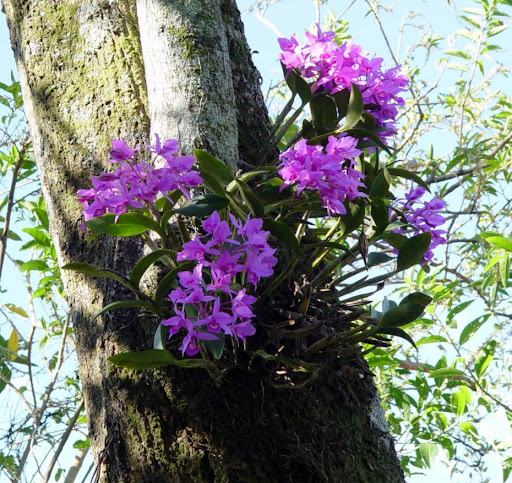
The "Guaria Morada" (Cattleya skinneri ), an orchid, was designated the National Flower of Costa Rica on June 15, 1939. The Guaria Morada grows on trees, roofs, and buildings. It gets nutrients from the air, rain, dust, and residues stored on the trunk of trees. These plants use trees as a means of support, but they are not parasites. The orchid' flowers are large with fantastic shapes, amazing colors, and enchanting fragrances.

The most beautiful and numerous orchids are grown in tropical countries. They are an essential part of tradition and folklore. There are nearly 15,000 species around the world, one of the plants with the largest variety in the world.

Meaning:

The Guaria Morada has always been in Costa Rican homes for centuries. The "campesinos" cherish the flower for its beauty and they associate it with the beauty of Costa Rican ladies. It has given Costa Rican people an aesthetic sense for appreciating nature and pursuing its beauty.

According to Native Costa Rican traditions, the Guaria Morada brings fortune and good luck. It brings union and family understanding and channels the best cosmic experiences. It evokes peace and love as well as hope for the future. Its flower does not have a special fragrance because it is filled with dreams to be accomplished.

Monday, November 24, 2008

The Coats of Arms


The first coat of arms that was used in Costa Rica was the United Provinces of Central America. that was until 1848.

When Costa Rica formed part of the Central American Federation, they adapted the coat that was of the federation. From the 21st of April 1840, the coat of the Free State of Costa Rica was used, until the 20th of April of April 1842. Our present coat of arms was raised on the 29th of September, 1848. In 1964 the flag was modified to show seven stars that represented the seven provinces.

On the 5th of May of 1998 the official crest was established, preserving the clear green of the mountains, and the blue green of the volcanoes, the color of the sun like a rusty gold, and the dark green of the myrtle palms.

The stars would be silver and the ribbon, a light blue. In addition the smoke from the volcanoes was depicted.


Friday, November 21, 2008

The Visual Images

The national symbols of Costa Rica are the flag, the coat of arms, the anthem, the national flower, the card, the deer, the national tree and the national bird.

Our Flags
The first independent provincial flag was used to represent Costa Rica on the 10th of May, 1823. The second flag of the United Provinces of Central America was created on the 6th of March 1824 and was present until 1840. The third flag of the Free State of Costa Rica was created on the 21st of April, 1840 and was discredited after the separation of Costa Rica from the Central American Federation and the fourth flag was discredited during the administration of Doctor Jose Maria Castro Madriz, on the 29th of September, 1848. There have been some amendments, but it is basically the same flag that we use today.